Ofqual-regulated qualification
Practical workplace first aid training
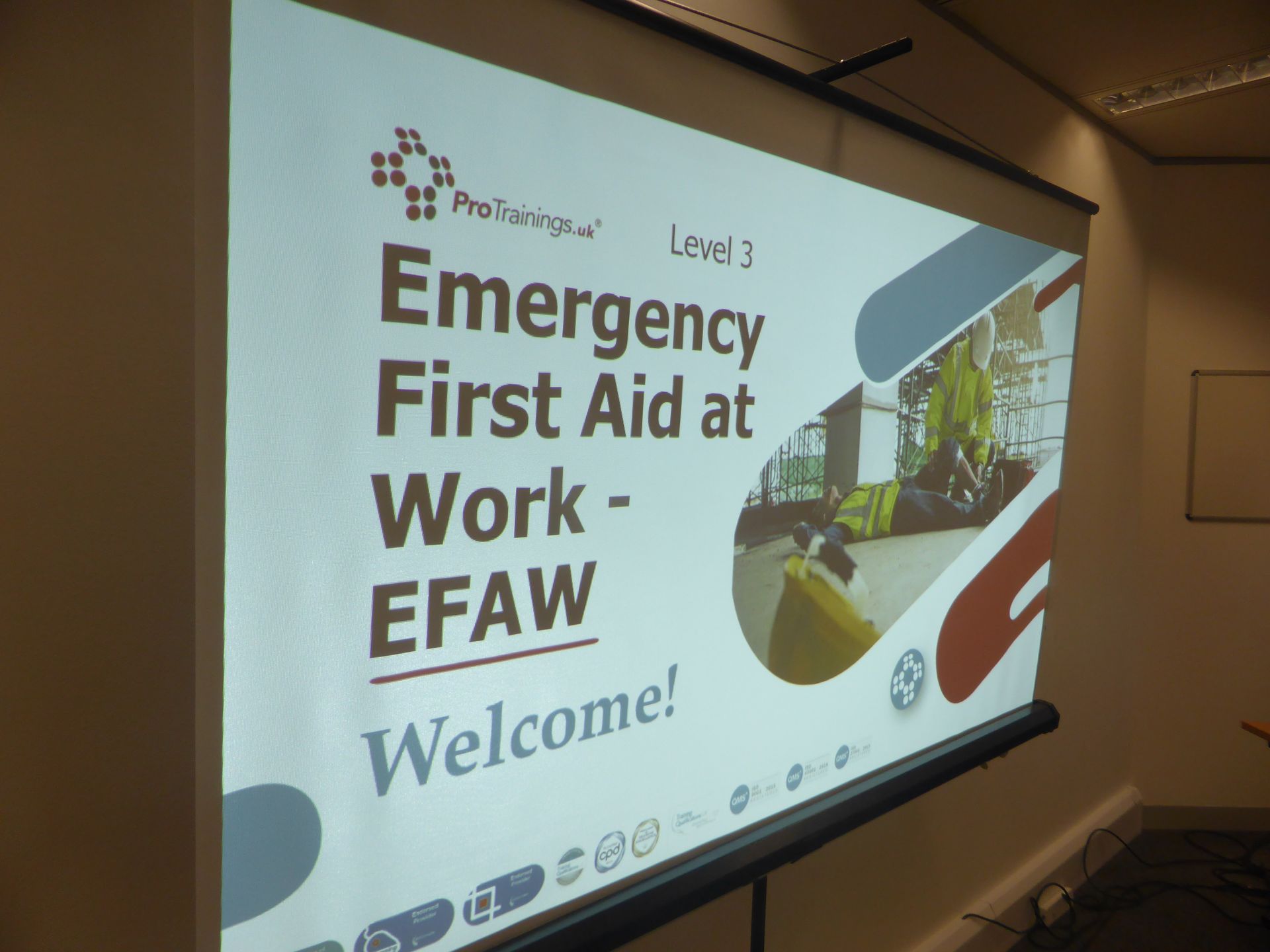
TQUK Level 3 Award in Emergency First Aid at Work (RQF)
Give your team the practical skills and confidence to respond when someone becomes injured or suddenly unwell at work. This engaging one-day regulated course includes CPR, AED use, choking and life-threatening bleeding.
Learn by doing
Clear demonstrations, individual practice and realistic
emergency scenarios.
1
One-day course
Seven-hour training day, including scheduled breaks.
RQF
Regulated award
Awarded through Training Qualifications UK.
AED
AED included
Hands-on CPR and defibrillator practice.
12
Up to 12 learners
Delivered at your workplace or suitable arranged venue.
Course overview
Regulated training with a strong practical focus
The TQUK Level 3 Award in Emergency First Aid at Work (RQF) is designed for people who may be required to provide immediate first aid within their workplace.
Learners are guided through the first critical stages of an emergency: checking for danger, assessing the casualty, calling for help and delivering appropriate care until the emergency services arrive.
The course combines clear knowledge development with repeated practical exercises and realistic scenarios. This helps learners understand not only what action to take, but why it matters and how to respond when an incident does not look like a perfect classroom example.
AED training is included as standard, together with CPR, choking, seizures, burns, shock and the management of serious and life-threatening bleeding.
Regulated qualification details
Clear, verifiable qualification information
The qualification is regulated within the Regulated Qualifications Framework and awarded by TQUK.
Learner outcomes
Confidence to take the next appropriate action
By the end of the course, learners should be able to recognise an emergency, make the area safer and provide immediate care within the limits of their training.
Assess the situation
Check for danger, identify immediate risks and complete a structured primary survey.
Get appropriate help
Call the emergency services, provide useful information and organise assistance from people nearby.
Deliver CPR
Recognise cardiac arrest and perform effective CPR using current first-aid principles.
Use an AED
Apply a training defibrillator safely while continuing effective CPR.
Control serious bleeding
Identify significant blood loss and take prompt action to reduce life-threatening bleeding.
Monitor and reassure
Place a casualty appropriately, monitor their condition and provide a clear handover when help arrives.
Who is the course for?
Relevant across many workplace settings
The qualification is suitable for nominated workplace first aiders, self-employed people and employees who may need to respond during the first minutes of an emergency.
Security officers and door supervisors
Offices and professional services
Construction and building trades
Factories and manufacturing
Warehousing and distribution
Agriculture and land-based work
Sports and leisure organisations
Outdoor pursuits and exploration
Service industries
Self-employed professionals
Students seeking relevant development
Small and medium-sized businesses
Choosing the correct course: EFAW may be suitable where an employer’s first-aid needs assessment identifies a requirement for emergency workplace first aid. Higher-hazard, remote or more complex workplaces may require the three-day First Aid at Work course and/or additional specialist training.
Course content
What learners will cover
The syllabus is organised into clear learning areas so you can review the scope without navigating one long list.
01 The first aider and workplace responsibilities
- About first aid
- The role of the first aider
- Acts, regulations and guidance
- First-aider duties and limitations
- Workplace first-aid provision
- First-aid kits
- Accident and incident reporting
- RIDDOR awareness
- Additional workplace duties
- Patient consent
- Fears and barriers to providing first aid
- Preserve life, prevent deterioration and promote recovery
02 Assessing an incident and getting help
- The importance of acting quickly
- Checking for danger
- Initial assessment and primary survey
- Checking and opening the airway
- Checking for normal breathing
- Calling for emergency help
- Call first and call fast considerations
- Using what3words to identify a location
- Recovery position
- Spinal injury considerations
- Monitoring a casualty
- Handing over to emergency services
03 CPR, AED and life-threatening emergencies
- The chain of survival
- Heart attack recognition
- Sudden cardiac arrest
- Adult CPR
- CPR with rescue breaths
- Compression-only CPR
- Mouth-to-nose rescue breaths
- Agonal breathing
- CPR during or following a seizure
- CPR considerations for a pregnant casualty
- Child CPR considerations from one to eighteen years
- Infection-control considerations
- AED operation and safety
- Combined CPR and AED practice
- Choking emergencies
04 Bleeding, shock, burns and seizures
- The circulatory system
- Minor bleeding
- Serious bleeding
- Life-threatening bleeding
- Wound care
- Dressings and bandages
- Nosebleeds
- Recognition of shock
- Treatment of shock
- Burns and scalds
- Minor injury treatment
- Epileptic seizures
Practical learning
More participation, less waiting
The training setup is designed to give learners meaningful practice time and experience using different types of first-aid training equipment.
One CPR manikin per learner
Each learner has dedicated access during CPR practice, allowing more repetition, individual feedback and less time waiting to share equipment.
Multiple-manufacturer AED trainers
Learners practise with training defibrillators from leading manufacturers and develop skills that transfer between different devices.
Stand-up choking manikins
Two stand-up choking manikins are shared during the choking module for realistic back-blow and abdominal-thrust practice.
Realistic scenarios
Learners apply their skills within practical scenarios that require assessment, communication and clear decisions.
Wider qualification value
Relevant to education, employment and licence-linked training
The regulated qualification may provide additional value where formal recognition or verifiable qualification evidence is important.
8
UCAS Tariff points
Potential support for a university application
This regulated qualification is currently recognised within the UCAS Tariff and can contribute eight Tariff points to an application.
Universities and course providers set their own entry requirements and decide whether and how Tariff qualifications are considered. Learners should check directly with the institution before relying on the points for a particular application.
Security-sector relevance
Door supervision and security guarding
An Emergency First Aid at Work qualification, or accepted equivalent, is required before learners begin relevant SIA door-supervisor or security-guard licence-linked training and refresher training.
The certificate must normally have at least twelve months remaining when the SIA licence-linked training begins. Learners should confirm acceptance and timing with their SIA training provider before booking.
Workplace first-aid provision
Supporting an employer’s first-aid arrangements
The course covers the recognised Emergency First Aid at Work learning outcomes and supports employers in providing trained personnel under the Health and Safety (First-Aid) Regulations 1981.
Employers remain responsible for completing a suitable first-aid needs assessment and deciding the number of first-aiders, level of training, equipment and facilities their workplace requires.
HSE does not approve individual first-aid training providers or general workplace first-aid qualifications. Employers should therefore select a competent provider and confirm that the course is appropriate for their circumstances.
Arranging your course
A clear route from enquiry to delivery
Training is delivered at your workplace or a suitable venue arranged by your organisation, reducing learner travel and allowing scenarios to reflect your working environment.
Tell us what you need
Provide your preferred dates, location, expected learner numbers and any relevant workplace requirements.
Receive a clear quotation
We will review the information, confirm availability and provide a quotation without obligation.
Confirm the arrangements
Once the quotation is accepted, complete the detailed booking form. The booking is confirmed after the issued invoice has been paid and cleared.
Common questions
Helpful information before you enquire
Is this the regulated version of the EFAW course?
Yes. Successful learners achieve the TQUK Level 3 Award in Emergency First Aid at Work (RQF), qualification number 603/2170/2.
How many learners can attend?
The maximum group size is 12 learners on each course day. This supports appropriate supervision, practice and assessment.
Is AED training included?
Yes. Learners practise CPR and the safe use of automated external defibrillators during the course.
Is the course suitable for every workplace?
Not automatically. Employers should use their first-aid needs assessment to decide whether EFAW provides the appropriate level of training. Some workplaces require First Aid at Work or additional specialist provision.
Where is the course delivered?
Courses are delivered at the customer’s workplace or at a suitable venue arranged by the customer. The room must provide enough space for practical floor-based activities.
When is the booking confirmed?
Submitting an enquiry or booking form does not itself confirm a date. A booking is confirmed once the quotation has been accepted and the issued invoice has been paid and cleared.
Ready to take the next step?
Bring regulated first-aid training to your workplace
Tell us where the training is required, how many learners need to attend and your preferred dates. We will review your requirements and respond with clear next steps.
Already accepted a first-aid quotation? Complete the booking formCourse suitability, qualification acceptance and any additional training requirements should be checked against your organisation’s first-aid needs assessment, contractual requirements and any applicable sector guidance.